
Choosing a reliable cosmetics OEM/ODM manufacturer is one of the easiest places for a brand to make a costly mistake — and one of the hardest to judge from a quote alone. When prices are similar, these 8 criteria are what actually determine how smoothly the partnership goes.
1. Certifications on file
GMPC (Good Manufacturing Practice for Cosmetics), ISO 22716 (the international cosmetics GMP standard), and FDA registration if you’re selling into the US market are the baseline. These aren’t nice-to-haves — they’re the precondition for customs clearance, marketplace listing, and passing third-party testing later.
2. Cleanroom grade and production capacity
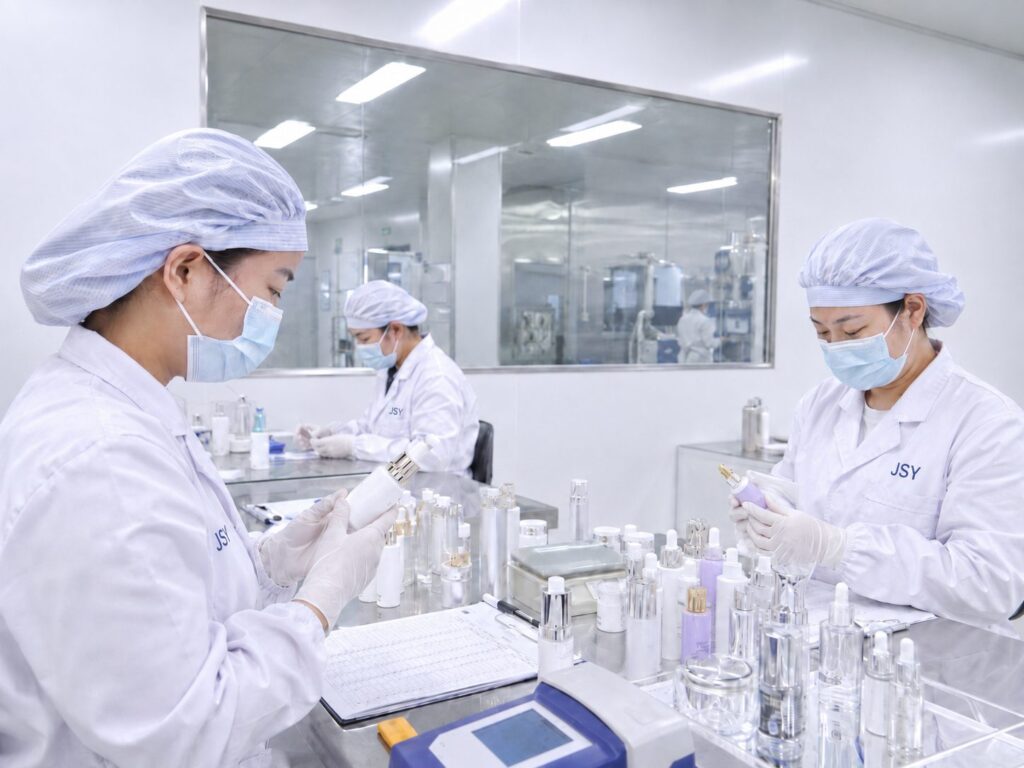
Cleanroom classification, number of production lines, and maximum batch size determine whether a factory can scale with you from a small pilot run to full-volume production without the process breaking down at the scale-up stage.
3. In-house formula R&D
Can the factory only manufacture to spec, or does it have its own R&D team and a library of proven formulas? A strong formula library usually means faster sampling and more flexibility to fine-tune texture, scent, and actives for a differentiated product.
4. Ingredient sourcing
Are core ingredients sourced from recognized international suppliers (Dow, Givaudan, BASF, Croda, etc.)? This directly affects product safety, stability, and — often — your own marketing story around ingredient provenance.
5. MOQ flexibility
Emerging brands and established brands have very different tolerance for minimum order quantities. Whether a factory can run a small test batch is often the deciding factor for a new brand’s first order.
6. Sampling and production lead time
Typical industry sampling takes 7-15 business days, with standard production runs at roughly 30-45 days. A quote well outside that range is worth a follow-up question.
7. Compliance and ingredient screening
Does the factory have a dedicated compliance function screening for restricted ingredients and handling regulatory registration? This is what keeps you out of trouble as regulations tighten across markets.
8. After-sales and batch traceability
If a batch issue surfaces after shipping, can the factory trace it back to the exact production run and raw material lot? Most brands only think to ask this after something has already gone wrong.
Checking a potential partner against these 8 points — rather than just comparing line-item quotes — is what separates a one-off order from a manufacturing relationship that actually lasts.